
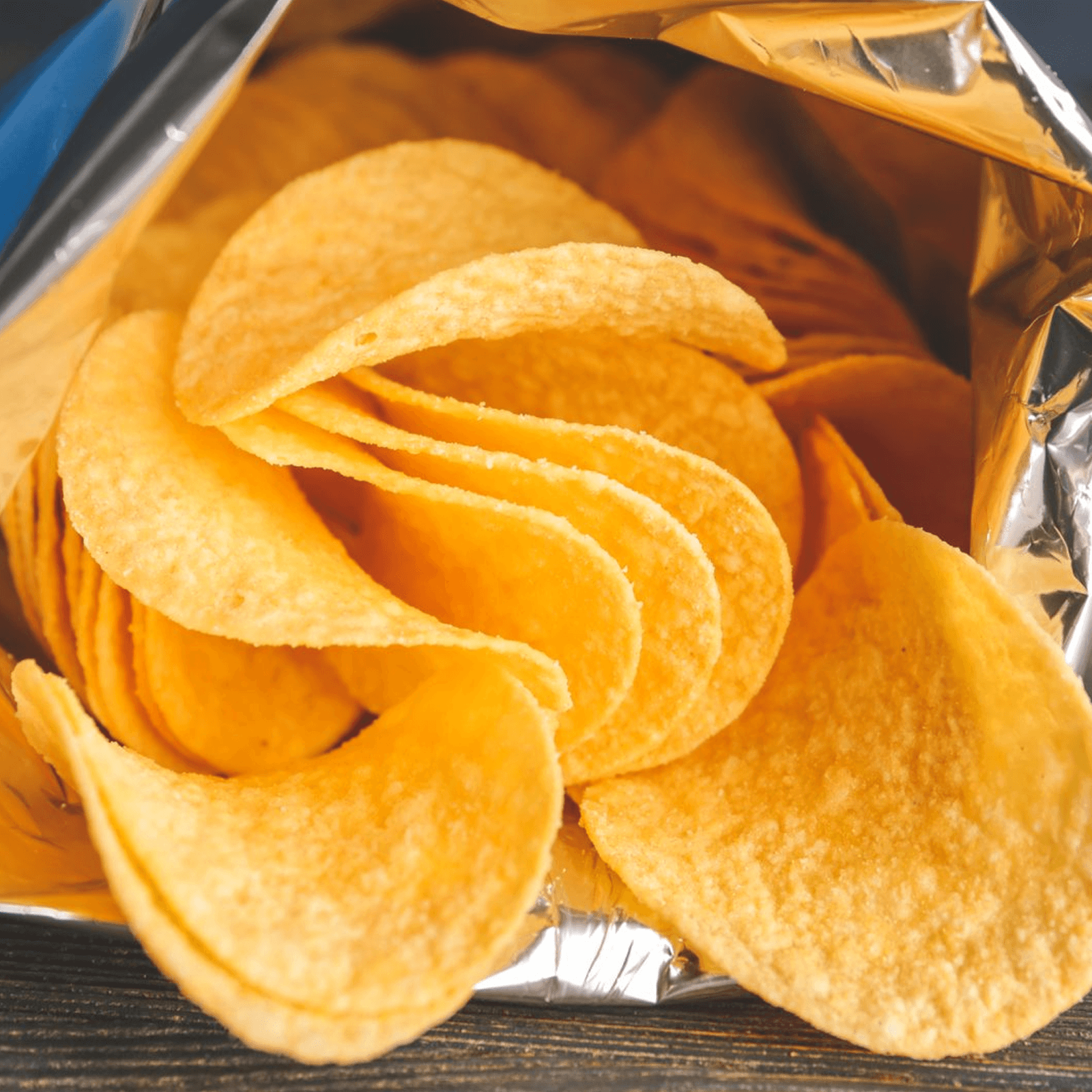
Unlike natural, fresh-cut potato chips that are sliced and fried immediately,Formed ChipsMade primarily from whole potato flour (including snowflake whole potato flour and some granulated flour), the product is produced by mixing the flour with water, followed by sheeting, shaping, and then deep-frying or baking. This complex production process highlights the physical properties of the whole potato flour—especiallyParticle Size Distribution and Bulk Density...which directly determines the uniformity of the finished potato chips' texture and the production line's yield rate.
For formulators of snack puffed foods, “using good flour” certainly does not mean blindly “using fine flour”; rather, it means finding a flour that matches the equipment’s water absorption capacity and mixing speed within the specific process window of the production line.Optimal Fineness Range. This is precisely“Custom-Grade Grinding”The fundamental reason why this concept has made such a big impact in the production of potato snowflake powder.
I. Why Does the Shaping of Composite Potato Chips Depend So Heavily on the Fineness and Bulk Density of the Potato Flour?
If the powder is too coarse, the dough absorbs water unevenly, making it highly prone to developing “dry cores” during mixing, and resulting in significant variations in internal porosity after sheeting. During the frying process, excessively high localized water vapor pressure can cause the potato chips to expand excessively, leading to a criticalUncontrolled Bubble Defects。
If the powder is too fine, the specific surface area increases dramatically, causing the entire powder to absorb water too quickly and resulting in excessive viscoelasticity in the dough. This makes the dough extremely prone to “sticking to the rollers” during the rolling process, which in turn leads to continuous tearing of the dough sheet—both of these extreme conditions directly increase the breakage rate on the composite potato chip production line.
In the recipe,Potato Snow FlakesIt retains the intact starch cell walls and has strong water-absorbing properties, serving as the framework that provides cohesion to the potato chip dough; whereasGranulesBecause the cells are free-flowing and more mobile, they are often used as additives to adjust dough density and reduce moisture content. Therefore, whole-grain flour mills must have the capability to perform “customized grinding and grading” of these two types of flour separately in order to perfectly match the formulations of downstream puffed food manufacturers.
II. Investigation of Dough Breakage During Rolling and Bubbling During Frying Caused by Uneven Grinding in Traditional Methods
Many contract manufacturers and small-to-medium-sized potato starch companies on the market still use outdated “fixed-speed hammer mills.” This crude processing method often creates three structural pitfalls in production lines when handling potato raw materials with high starch content:
-
1
The particle size distribution is extremely broad, and the proportion of ultrafine particles is uncontrollable.
At a constant rotational speed, both coarse particles and ultrafine powder are present. Ultrafine powder (For every 5% increase in the proportion of <60 mesh material, the viscosity of the end customer’s dough fluctuates by approximately 8%–12%, forcing production line operators to frequently adjust the calendering line speed manually, which significantly reduces automation efficiency.
-
2
Localized overheating causes “secondary pregelatinization” of starch”
The instantaneous heat generated by high-speed impact in older-style crushers can cause the temperature in certain areas of the chamber to briefly exceed 60°C. The water-absorption properties of the pre-gelatinized starch undergo a sudden change, forming hard, unyielding pockets within the dough—which is why the surface of fried potato chips appearsLocalized large bubbles or delamination defectsThe culprit.
-
3
The End Point of the Chain Reaction Caused by a Broken Noodle Sheet
Uneven particle size and bulk density result in significant local variations in belt strength. When tension is applied by the high-speed calendering rollers, the weaker sections of the belt fracture first. On high-speed potato chip production lines, the loss from a single belt break (including downtime for cleaning and scrap) typically amounts to 15–30 minutes’ worth of production output.
III. How Does the Flexible Variable-Frequency Grinding System Achieve Precise Customization of “Mesh Size”?
Junsheng Technology's fully automated production lines come standard withFlexible Variable-Frequency Crushing System. With a core architecture based on “variable-frequency motor drive + online airflow classification + intelligent temperature control coupling,” this system has completely revolutionized the traditional, crude process of “changing screens to achieve a specific mesh count.”
| Control Dimensions | Traditional Hammer Mill System | Junsheng Flexible Variable-Frequency System (Recommended) |
|---|---|---|
| Rotational Speed and Particle Size Control | Fixed speed; relies on manual screen changes | 0–1001 TP3T stepless variable-frequency drive, particle size CV value reduced by 401 TP3T |
| Temperature Rise and Gelatinization Control | Passive cooling; starch prone to gelatinization at high temperatures | Low-speed grinding + cold air circulation, chamber temperature maintained at ≤45°C |
| Air Classification of Fine Powder | Single-layer screen, mixed-size output | Multi-stage airflow separation for precise removal of ultrafine particles |
| Batch-to-batch consistency of bulk density | The batch-to-batch variation rate is as high as ±12% | Real-time bulk density monitoring and feedback ensure an absolutely stable water-to-cement ratio |
Bulk density and particle size are not linearly correlated. Even for 60-mesh snow powder, differences in bulk density can reach ±15% due to variations in the raw material’s origin and harvest season. If the source full-powder factory cannot provide consistent bulk density specifications across batches, the water addition (water-to-powder ratio) at downstream snack food manufacturers will become completely uncontrollable.
IV. Quality Closed-Loop System: Efficient Integration of Raw Materials and Final Production Lines
For large-scale snack puffing manufacturers, choosing potato flour with “custom-mesh grinding” is not merely about meeting individual quality standards; rather, it serves as **an interface between the raw material and production line**, delivering significant hidden benefits in terms of cost reduction and efficiency gains for the factory.
1. Permanent fixation of SOP parameters for downstream production lines
Once the particle size and bulk density of the whole-grain powder are consistently standardized by the major source manufacturers, food manufacturers can establish fixed SOPs for the water-to-mix ratio, calender roll speed, and frying temperature curves that do not require modification. This completely eliminates reliance on operator experience and achievesCross-Plant, Cross-Line Quality 100% Copy。
2. Accelerating Traceability and New Product Development
Junsheng Technology’s system automatically records the grinding parameters for each batch and can integrate seamlessly with major clients’ MES production systems. When testing new potato chip formulations, we can precisely simulate the target particle size conditions as early as the pilot-scale testing phase, significantly reducing distortion rates during the client’s scale-up process. This shortens the cycle from finalizing the formulation to full-scale production by an average of 20%–35%.
Conclusion:The battle for high-quality yields in composite potato chips is, at its core, about precisely mastering the physical properties of raw materials. “Custom mesh size” is by no means just a marketing buzzword; it serves as the fulcrum for transforming raw material fluctuations into controllable variables and turning workers’ experience into data-driven standard operating procedures (SOPs). Choosing a major source manufacturer equipped with flexible variable-frequency crushing technology means choosing a path of rapid expansion characterized by high yield rates and low internal waste.