Among all potato snowflake powder production equipment,Single-Cylinder Drum DryerIt is the core component that determines the final film quality and physical properties. So-called “burn spots” are by no means an isolated surface issue; they are often an outward sign of localized instability in the temperature distribution within the drum. Rather than waiting for burn spots to appear before emergency shutdowns and cleaning, it is better to establish a scientific daily inspection mechanism, transforming “firefighting after the fact” into “defusing potential problems before they arise.”
I. Causes of scorch marks in single-cylinder drum dryers: Malfunctions in the steam piping network and siphon system
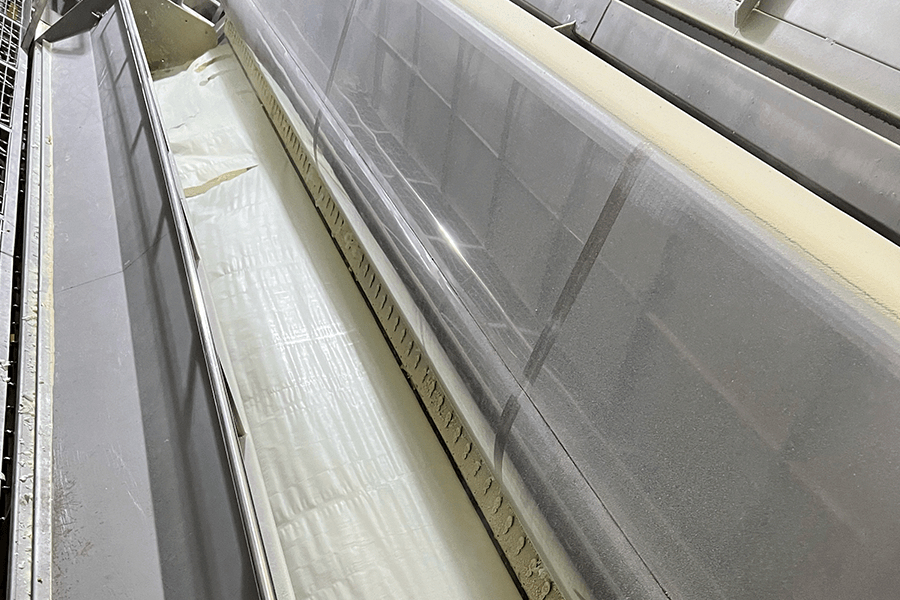
A single-cylinder drum relies on the heat released by the condensation of saturated steam inside the drum to provide energy to the material. OnceFluctuations in Vapor Pressure in Drum DryersIf the rotation is too vigorous, or if condensate drainage through the siphon tube is obstructed, a “water cushion” will form on the inner wall of the cylinder. Heat transfer efficiency in these areas of water accumulation drops sharply, creating a significant temperature difference compared to the surrounding high-temperature zones. The mashed potatoes located at the edge of this temperature gradient are most prone to scorching first, as the duration of local heating is unpredictable. These scorch marks typically appear in stripes or patches and recur periodically as the drum rotates.
1. Record the steam supply pressure curve for each shift; if the fluctuation exceeds ±0.05 MPa, inspect the condition of the pressure-reducing valve.
2. Inspect the rotary joint seals weekly, and periodically (recommended monthly) disassemble and inspect the insertion depth of the siphon tube and the wear on the tube opening.
3. Check the discharge temperature of the steam trap to ensure there is no steam bypass.
II. Incorrect pneumatic scraper clearance or blade wear: localized “burned-on residue”
The primary function of the scraper is to promptly and evenly remove the potato slurry from the surface of the drum after it has gelatinized and dried. If the overall pressure setting of the pneumatic scraper is too low, or if a section of the blade develops notches or curled edges due to long-term wear, the thin layer of material residue in that area will be repeatedly heated during the next rotation cycle, eventually carbonizing and forming scorch marks. These scorch marks, caused by mechanical wear, are extremely dark in color and hard in texture, and they typically occur in specific axial sections where the scraper is damaged.
-
1
Matching Blade Material and Hardness
If the blade material is not hard enough, it will wear out too quickly; conversely, if it is too hard, it may damage the drum surface. A strict blade wear log must be maintained to record replacement intervals, and it is strictly prohibited to use a blade until it is completely worn out.
-
2
Cylinder Pressure Decay Compensation
Monitor the pressure gauge readings on the scraper cylinders regularly. If you notice that the pressure across an entire row of scrapers gradually decreases over time, perform compensatory calibration or repair the air line seals promptly.
III. Uneven Pressure on the Fabric Roller (Coating Roller): A Potential Cause of Inconsistent Film Thickness
The satellite coating roller evenly applies the potato slurry to the surface of the main drum, serving as the first critical step in ensuring uniform drying throughout the potato flour production line. If the clamping force at both ends of the feed roller differs from that in the middle section—a common issue caused by a bent roller shaft, worn bearing housings, or unbalanced hydraulic pressure—the material film will develop a critical problem: “thick in the middle and thin at both ends.” In areas where the material film is extremely thin, the drying rate is too fast, making it highly prone to the formation of flaky scorching.
Key Points to Watch Out For: If the scorch marks along the cylinder axis follow a symmetrical pattern—such as “present at both ends but not in the middle” or “present in the middle but not at both ends”—immediately stop inspecting the steam system and first check the parallelism of the feed rollers and the pressure gauge readings!
IV. Maintenance and Repair of Upstream Starch Processing Equipment: The Adhesion Nightmare Caused by Damaged Starch Cells
Severe charring on the drum surface is sometimes blamed for process control issues in upstream stages. In the potato washing, pre-cooking (enzyme inactivation), and cooking stages, the core of the process is maintaining the integrity of the starch cells.
Incomplete gelatinization (raw starch)This often results in “white specks” scattered throughout the product. However, the real culprit behind large-scale scorched spots is overcooking or excessive mechanical shear from upstream pumping equipment, which causes starch cells to rupture and release large amounts ofFree starch. This free starch causes the slurry to become extremely thick and pasty, clinging tightly to the surface of the drum. The scraper cannot completely remove it, and after several cycles of high-temperature baking, it eventually forms hard, black, caked-on stains that are difficult to remove.
| Categories of Causes of Death | Physical Characteristics of Scorch Mark Distribution | Recommendations for Inspection Responsibilities and Frequency |
|---|---|---|
| ① Fluctuations in the Steam Distribution Network and Siphon Anomalies | It forms a band-like pattern along the axial direction and repeats periodically as it rotates. | Power Plant Operator: Record pressure for each shift / Perform a thorough disassembly and inspection once a month |
| ② Incorrect scraper clearance / Damaged blade | Specific axial sections remain fixed and are dark in color and hard in texture | Machine Maintenance Team: Visual inspection per shift / Weekly feeler gauge measurement |
| ③ Uneven hydraulic pressure in the satellite fabric feed rollers | They are distributed in a clearly symmetrical pattern at both ends or in the middle of the cylinder | Drying Station: Check parallelism before each startup |
| ④ Rupture of upstream cells (sharp increase in free starch) | The entire cylinder is covered with large patches of black soot that adhere strongly. | Processing Position: Conduct random inspections of cooking shear force and strictly control the cell damage rate to <3% |
Summary: As a central challenge in the maintenance of starch processing equipment, eliminating scorch spots requires moving beyond a purely mechanical perspective and integrating food thermodynamics and rheology. Incorporating the core parameters from the four dimensions mentioned above into the daily “Whole-Starch Production Line Risk Assessment Checklist” is the fundamental path to achieving high yield rates and minimizing downtime losses.